

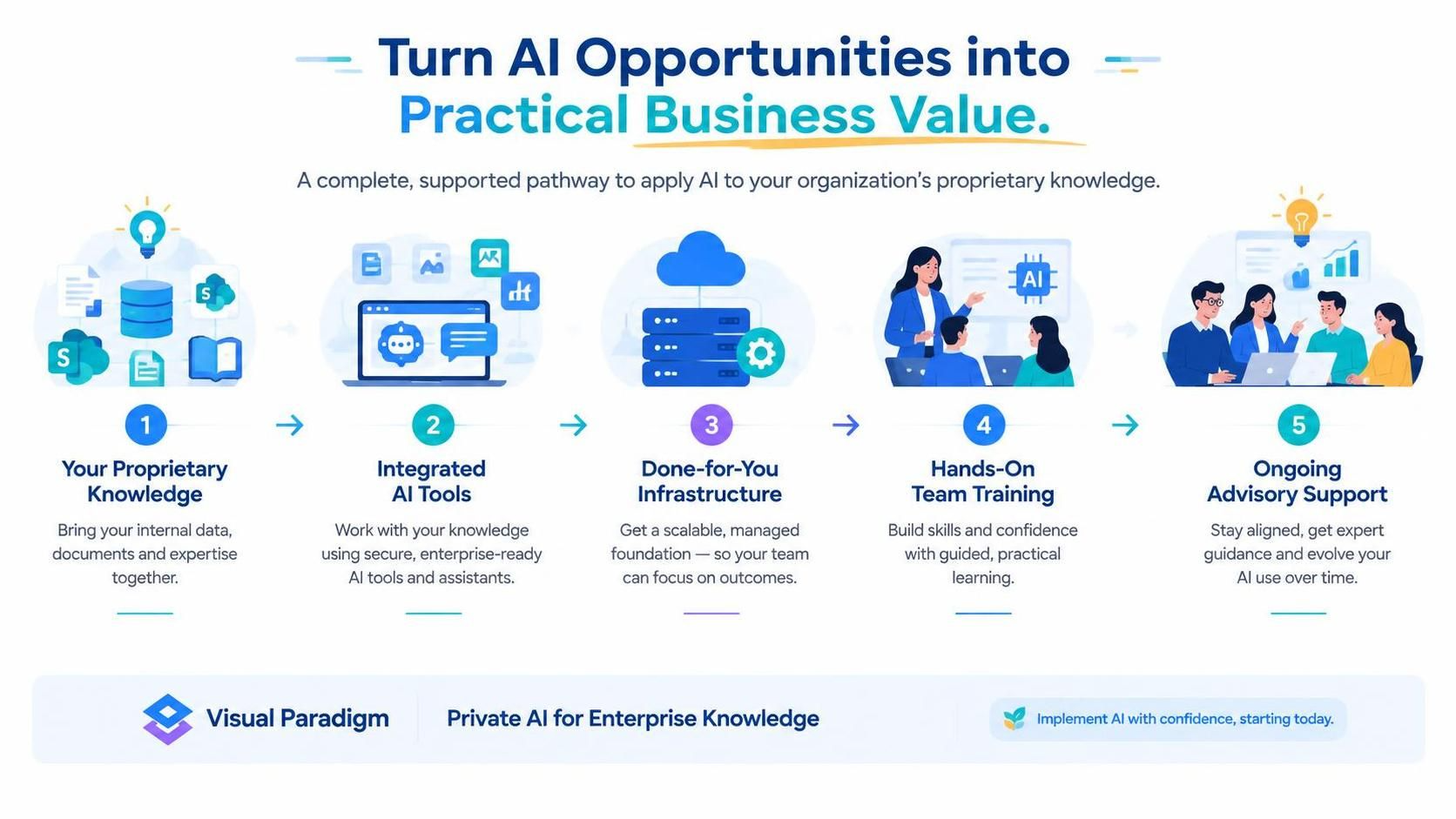
Transitioning from theoretical Artificial Intelligence concepts to tangible, secure, and high-value business applications requires a robust architectural framework. Visual Paradigm’s Private AI for Enterprise Knowledge solution represents a holistic approach to this challenge. Rather than deploying isolated tools, this system architecture is designed as an integrated ecosystem. It bridges the gap between static organizational data and dynamic, interactive AI capabilities.
This tutorial dissects the core components of this architecture, explaining how an enterprise moves from raw data to a fully operational, secure AI environment through a five-stage process.
The Strategic Architecture: A 5-Stage Pipeline
The implementation of a Private AI ecosystem is not a singular event but a pipeline. The architecture follows a logical flow that ensures data integrity, security, and user competence. Below is a detailed breakdown of the five architectural stages depicted in the Visual Paradigm solution.
Stage 1: The Data Foundation (Your Proprietary Knowledge)
The architecture begins at the source: the organization’s internal data. In a private AI context, the “brain” of the system is not a public model but the specific knowledge held by the enterprise. This stage represents the ingestion of proprietary assets.
- Input Sources: The system is designed to aggregate data from diverse formats. This includes structured databases, unstructured documents, technical manuals, and expertise repositories.
- Centralization: The goal is to bring these disparate data points together into a unified knowledge base. This ensures that the AI does not hallucinate based on external internet data, but rather retrieves answers based on the company’s specific reality.
Stage 2: The Application Layer (Integrated AI Tools)
Once the knowledge base is established, the architecture moves to the application layer. This is where the raw data becomes accessible through secure, enterprise-ready interfaces.
Visual Paradigm integrates AI tools directly into the workflow. Instead of requiring users to navigate complex command-line interfaces or external web portals, the AI assistants are embedded within the software environment. This stage focuses on:
- Security: Ensuring that interactions with the AI do not leak sensitive data to public clouds.
- Usability: Providing intuitive chat interfaces and assistants that allow employees to query the knowledge base naturally.
Stage 3: The Infrastructure Layer (Done-for-You Infrastructure)
A critical component of this architecture is the underlying infrastructure. For enterprise adoption, the infrastructure must be scalable, managed, and secure. The “Done-for-You” aspect implies that the technical complexity of hosting, scaling, and maintaining the AI model is abstracted away from the user.
Key Architectural Benefits:
- Self-Hosting Capability: This allows for on-premise or private cloud deployment, ensuring data sovereignty.
- Managed Foundation: The infrastructure is pre-configured to handle the computational load of Large Language Models (LLMs), allowing the team to focus on outcomes rather than server maintenance.
Stage 4: The Human Factor (Hands-On Team Training)
Technology alone does not generate value; people do. The fourth stage of this architecture is the “Human-in-the-Loop” component. This involves structured, hands-on training to ensure the team can leverage the new tools effectively.
This stage is about building confidence and skills. It transforms the AI from a theoretical concept into a practical daily tool. The training is designed to be practical, guiding users on how to prompt, refine, and utilize the AI for specific business tasks.
Stage 5: The Evolutionary Cycle (Ongoing Advisory Support)
The final stage completes the loop with ongoing support. AI implementation is not a “set and forget” scenario. The architecture includes a feedback mechanism where expert advisory support helps the organization evolve its AI use over time.
- Continuous Alignment: Ensuring the AI remains aligned with changing business goals.
- Optimization: Refining the knowledge base and tool usage as the organization grows.
Technical Implementation Considerations
When adopting this architecture, technical stakeholders should focus on the integration points. The system is designed to be a “Total Solution,” meaning it minimizes the need for custom coding or disparate integration efforts. The core value proposition lies in the seamless flow of data from Stage 1 (Data) through Stage 3 (Infrastructure) to Stage 2 (Tools).
This architecture ensures that the “Private” aspect of Private AI is maintained throughout the entire lifecycle. From the moment data enters the system to the moment a user receives an answer, the data remains within the organization’s secure perimeter.
Conclusion
The Visual Paradigm Private AI for Enterprise Knowledge solution offers a comprehensive pathway for organizations to harness their proprietary data. By addressing the five critical pillars—Knowledge, Tools, Infrastructure, Training, and Support—this architecture removes the barriers to entry and accelerates the realization of practical business value. It transforms the future of business from a theoretical promise into an implemented reality.