

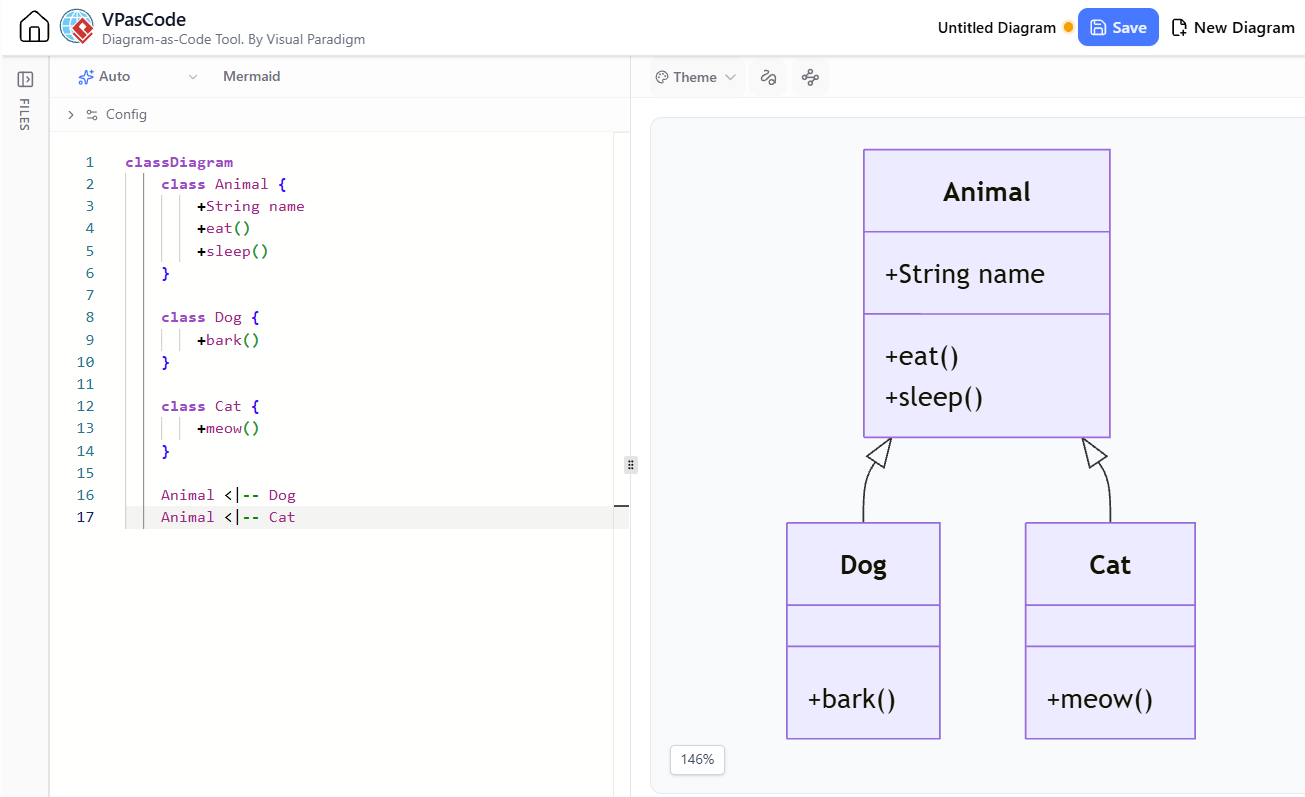
In the realm of software architecture and object-oriented design, clarity is paramount. One of the most fundamental tools we use to visualize the structure of a system is the Class Diagram. Whether you are designing a complex enterprise application or modeling a simple data structure, understanding how to define classes, their attributes, methods, and relationships is essential. This tutorial explores these core concepts using the powerful, text-based interface of VPasCode, demonstrating how code-first modeling can streamline your design process.
The Power of Abstraction: The “Animal” Class
Object-Oriented Programming (OOP) relies heavily on the concept of abstraction. Instead of defining every specific detail immediately, we define a general template. In our example, we begin with a class named Animal. This class serves as a blueprint for all living creatures within our system.
Inside the Animal class definition, we identify two distinct sections: the state (attributes) and the behavior (methods).
- Attributes: We define
+String name. The plus sign (+) indicates public visibility, meaning any other part of the system can access this data. The typeStringspecifies that this attribute holds text data. - Methods: We define
+eat()and+sleep(). These represent the generic behaviors that every animal in this model is expected to perform.
By encapsulating these shared traits in a single class, we adhere to the principle of DRY (Don’t Repeat Yourself). If we were to model a dog, we wouldn’t need to re-write the code for “eating”; we would simply inherit it.
Building Specialization: Dog and Cat
Once the general model is established, we introduce specialized subclasses. The diagram shows two new classes: Dog and Cat.
While these classes share the fundamental characteristics of an Animal, they possess unique behaviors. The Dog class introduces the +bark() method, and the Cat class introduces +meow(). In a visual representation, these classes appear as boxes containing only their specific details, but structurally, they are deeply connected to the parent.
The Relationship: Inheritance
The most critical concept in this diagram is the relationship between the general and the specific. In Object-Oriented modeling, this is known as Inheritance or Generalization.
Without this relationship, the Dog class would be an independent entity, unaware that it is an animal. To bridge this gap, we use a specific syntax in the VPasCode tool to link the classes:
Animal <|-- Dog
Animal <|-- Cat
The arrow notation <|-- is the standard Mermaid syntax for inheritance. It visually points from the subclass (Dog) up to the superclass (Animal), indicating that “Dog is a kind of Animal.” This relationship is vital because it allows the subclasses to automatically inherit the public attributes and methods of the parent class.
From Text to Visual: The VPasCode Workflow
One of the most appealing aspects of using tools like VPasCode is the seamless transition from code to visuals. You do not need to drag and drop boxes with a mouse. Instead, you write the structural logic in plain text. When you type the relationship line Animal <|-- Dog, the tool parses this instruction and automatically renders the class boxes and the connecting arrow in the diagram pane.
This “Diagram-as-Code” approach offers several advantages:
- Version Control Friendly: Text files can be easily managed with Git, allowing for better collaboration and history tracking compared to binary image files.
- Speed: Typing is often faster than navigating complex GUI menus to create and connect shapes.
- Consistency: The tool enforces syntax rules, reducing the likelihood of formatting errors common in hand-drawn diagrams.
Conclusion
Understanding class diagrams is the first step toward mastering system architecture. By defining classes like Animal, Dog, and Cat, and explicitly linking them through inheritance, you create a robust model that reflects real-world logic. Tools like VPasCode empower you to write this logic efficiently, ensuring your architectural plans are clear, concise, and ready for implementation.