

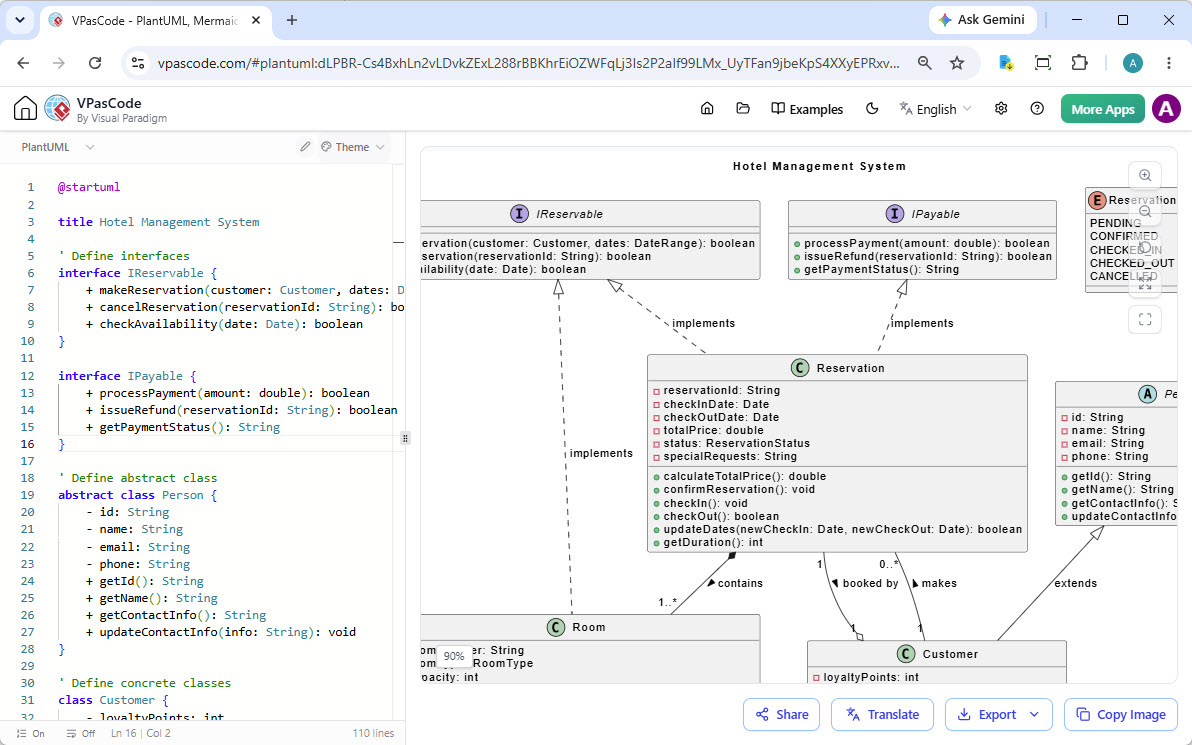
In modern software engineering, the ability to visualize complex system behaviors is just as critical as writing the code itself. This tutorial explores the architecture of a Hotel Management System using Unified Modeling Language (UML), specifically focusing on how abstract interfaces and concrete implementations interact within a cohesive design.
The Core Concept: Separation of Concerns
The fundamental principle behind the diagram presented in the VPasCode environment is the Separation of Concerns. By defining behaviors as interfaces, we decouple the “what” the system does from the “how” it does it. This allows the Hotel Management System to be flexible, scalable, and easier to maintain.
1. Defining the Behavior (Interfaces)
The architecture begins with two distinct contracts: IReservable and IPayable. These are not classes; they are blueprints that dictate specific behaviors any object in the system must adhere to.
- IReservable: This interface defines the lifecycle of a booking. It mandates that any reservable entity must be able to make a reservation, cancel it, and check availability.
- IPayable: This interface handles the financial aspect. It ensures that any entity engaging in a transaction can process a payment, issue a refund, and report its payment status.
In the diagram, these are represented by circles with the letter “I” inside, a standard convention indicating an interface. The dashed lines with open arrowheads pointing to these interfaces represent the “implements” relationship. This means the concrete classes below are legally bound to provide the logic for these methods.
2. Modeling the Core Entity: The Reservation
At the center of this system sits the Reservation class. It is the orchestrator of the hotel experience. Notice how it extends the capabilities of both interfaces:
- It includes attributes like
reservationId,checkInDate, andtotalPrice. - It contains methods to calculate the total price and handle the status of the reservation (e.g.,
checkIn,checkOut).
The relationship where Reservation implements IReservable and IPayable is visualized via dashed lines labeled “implements.” This confirms that the Reservation class provides the actual code logic for the abstract rules defined in the interfaces.
3. The Domain Objects: Room and Customer
A reservation cannot exist in a vacuum; it requires context. The system models this through two primary domain objects:
- The Room: Represented as a class with properties like
roomNumber,roomType, andcapacity. It is the physical asset being booked. - The Customer: This class holds the identity of the guest, including
id,name,email, andloyaltyPoints. It extends thePersonabstract class, inheriting common attributes like contact information.
4. Relationships and Multiplicity
The power of UML Class Diagrams lies in their ability to define relationships. The lines connecting these classes tell a story:
- Contains (Room to Reservation): The line connecting
RoomandReservationis labeled “contains.” The multiplicity “1” on the Room side and “1..” on the Reservation side indicates that one Room can have many Reservations over time (but only one active at a specific moment). - Booked By (Customer to Reservation): The relationship between
CustomerandReservationis “booked by.” The multiplicity “0..” on the Customer side implies a customer might have zero reservations (a new user) or many, while the “1” on the Reservation side ensures a reservation is always linked to exactly one customer.
Conclusion
By visualizing this architecture in VPasCode, developers gain a clear roadmap of how data flows between the guest, the room, and the booking process. This unified view prevents logical errors during coding and ensures that the financial and operational requirements are met structurally before a single line of code is written.