

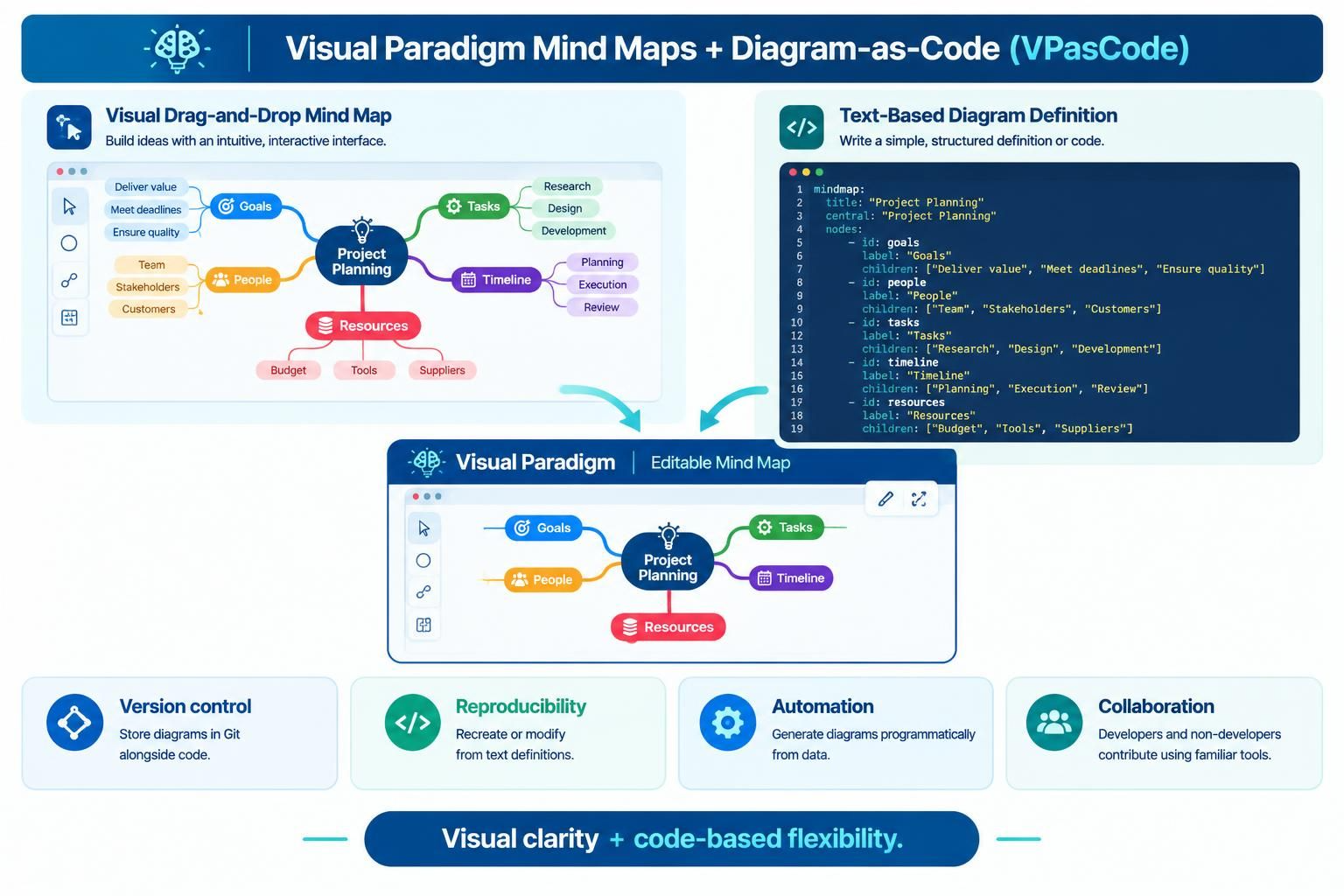
In the modern era of information overload, the ability to organize thoughts rapidly and structure complex ideas is a critical skill. While traditional linear note-taking has served us well, it often fails to capture the non-linear, associative nature of human creativity. This is where the Visual Paradigm Mind Map technology shines. By integrating intuitive visual interfaces with the power of Diagram-as-Code (VPasCode) and AI-assisted generation, Visual Paradigm offers a comprehensive solution for brainstorming, project planning, and knowledge management.
This tutorial explores how to leverage these advanced features to enhance productivity, clarify complex problems, and collaborate more effectively within your team.
1. The Core Philosophy: Visual Thinking Meets Code
Mind mapping is a visual thinking tool designed to structure information, helping you better analyze, comprehend, synthesize, recall, and generate new ideas. Unlike traditional linear notes, mind maps mimic the way our brains naturally work—radiating from a central concept and branching out into related subtopics.
Historically, mind mapping was limited to pen and paper or static drawing tools. However, the digital age has introduced a paradigm shift. We can now combine the visual intuition of drag-and-drop interfaces with the structural precision of code. This hybrid approach allows users to:
- Visualize complex relationships instantly.
- Code diagrams for version control and reproducibility.
- Automate the creation of maps from text or data.
2. Key Concepts and Anatomy of a Mind Map
To effectively use Visual Paradigm for brainstorming or knowledge organization, one must understand the fundamental elements that construct a robust mind map.
Central Idea
The core of any mind map is the central idea. This is the main topic, problem statement, or theme placed in the center of the canvas. It acts as the anchor for all other thoughts.
Branches and Sub-branches
Major categories or themes radiate from the center as branches. These branches represent the primary dimensions of the topic. Stemming from these major branches are sub-branches, which contain detailed points, tasks, or specific ideas. This hierarchy helps in breaking down large concepts into manageable chunks.
Keywords and Connections
Clarity is maintained by using keywords—concise labels on each branch rather than long sentences. Furthermore, connections (lines) can be used to link related ideas across different branches, highlighting non-linear relationships.
Example: Planning a Product Launch
Consider a scenario where you are planning a product launch. The central idea is “Launch AI Feature X.” The branches might include:
- Marketing: Social Media Campaign, Email Newsletter.
- Engineering: Backend API Integration, Frontend UI Updates.
- Sales: Training Materials, Pricing Strategy.
3. The VPasCode Advantage: Diagram-as-Code
While drag-and-drop interfaces are intuitive, they can sometimes lack the power of automation. Diagram-as-Code (specifically VPasCode in Visual Paradigm) bridges this gap. It allows you to define mind maps and other diagrams using code syntax, offering significant advantages for developers and technical teams.
Why Combine Visual Tools with Code?
- Version Control: Store diagrams in Git alongside your codebase. This allows you to track changes over time, just like software code.
- Reproducibility: Easily recreate or modify diagrams using text-based definitions. If you need to create a map for a similar project, you can copy and adapt the code.
- Automation: Generate diagrams programmatically from data sources. You can write scripts to pull data and automatically render the structure.
- Collaboration: Developers and non-developers can contribute using familiar tools. Code reviews can be applied to diagrams to ensure consistency.
Visual Paradigm supports VPasCode, integrating seamlessly with open-source diagramming languages like PlantUML and Mermaid. This means you can leverage the vast ecosystem of community-supported syntax while enjoying the rich visual rendering of Visual Paradigm.
4. AI-Assisted Generation
One of the most exciting developments in this field is the integration of Artificial Intelligence. Visual Paradigm’s AI-Assisted Features allow you to bypass the initial setup phase of diagramming.
Instead of manually adding nodes, you can simply input a natural language prompt. For example, you might ask the AI to:
“Create a mind map for organizing a team retreat including logistics, activities, and budget.”
The AI will generate a structured mind map based on your prompt. You can then refine this draft visually or by editing the code. This drastically reduces the time spent on the “blank canvas” problem.
5. Usage Cases Across Domains
Mind mapping is versatile and applicable across various professional and personal domains:
- Project Management: Break down large projects into manageable tasks, assign responsibilities, and track dependencies.
- Brainstorming & Ideation: Generate creative solutions for product features, marketing slogans, or business strategies.
- Learning & Study: Summarize complex topics, prepare for exams, or organize research notes.
- Meeting Agendas: Structure discussions, ensure all topics are covered, and capture action items in real-time.
- Problem Solving: Identify root causes of issues by mapping out symptoms, causes, and potential solutions.
6. Who Will Benefit?
This hybrid workflow is designed to support a wide range of professionals:
- Product Managers: To roadmap features, conduct user research, and align stakeholders.
- Developers & DevOps Engineers: For planning infrastructure, debugging workflows, and documenting system architecture.
- Students & Researchers: To organize thesis topics, literature reviews, and study materials.
- Business Analysts: For mapping out business processes, requirements, and stakeholder needs.
- Creative Professionals: Writers, designers, and marketers for brainstorming and content planning.
7. Standout Features of the Hybrid Workflow
Visual Paradigm + VPasCode offers a unique set of capabilities:
- Hybrid Workflow: Switch seamlessly between visual editing and code-based definitions.
- AI Integration: Automatically generate initial drafts from natural language descriptions.
- Multi-Format Support: Export to PDF, PNG, SVG, or integrate with Confluence, Jira, and GitHub.
- Collaboration: Real-time co-editing and comment threads for team feedback.
- Template Library: Pre-built templates for common use cases like SWOT analysis, project planning, and meeting agendas.
8. Tips and Tricks for Success
To get the most out of your mind mapping journey, consider the following best practices:
- Start Simple: Begin with a central idea and add branches gradually. Avoid overcrowding the map initially.
- Use Keywords: Keep labels short and impactful. Use single words or short phrases instead of sentences.
- Color Code: Assign colors to different branches to improve visual distinction and memory retention.
- Leverage AI for Drafts: Use AI to generate a first draft, then refine it manually to ensure accuracy and relevance.
- Version Your Code: If using VPasCode, commit changes to Git to track evolution and collaborate with teammates.
- Link to External Resources: Add hyperlinks to branches for detailed documents, tickets, or references.
- Iterate Regularly: Update your mind map as new information emerges or priorities shift.
Conclusion
Mind mapping is a powerful technique for organizing thoughts, solving problems, and driving collaboration. By combining the visual intuition of tools like Visual Paradigm with the precision and automation of Diagram-as-Code and AI assistance, you can create dynamic, maintainable, and insightful diagrams. Whether you’re planning a product launch, studying for an exam, or brainstorming your next big idea, mastering these tools will enhance your clarity, productivity, and creativity.