

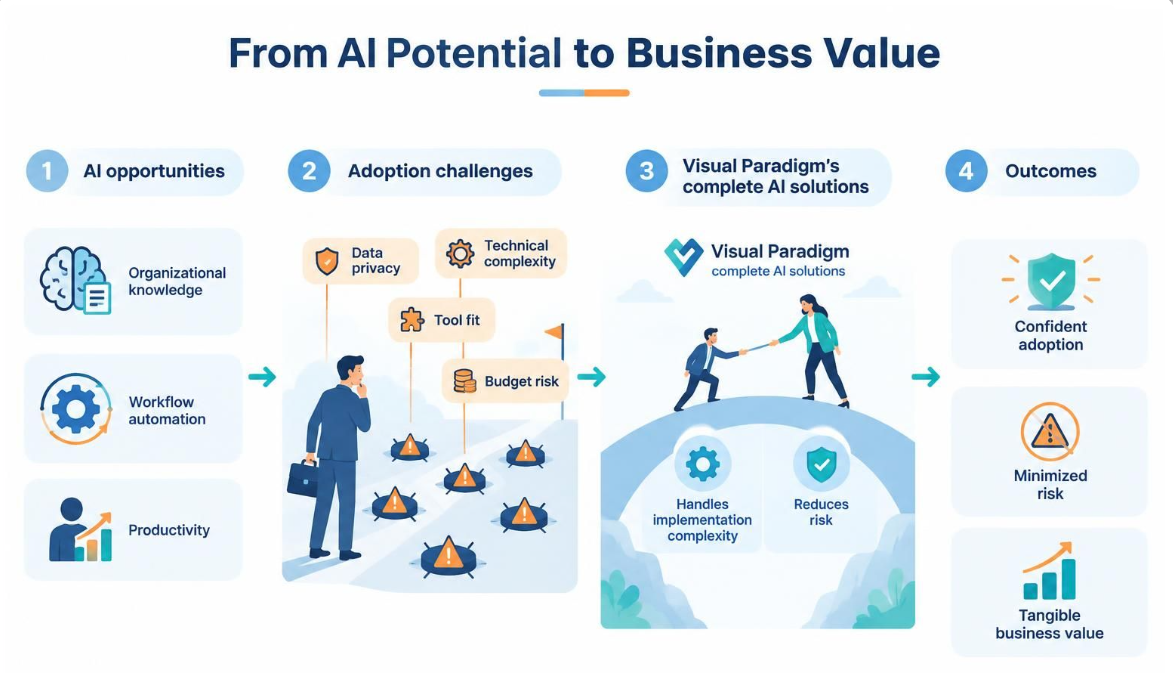
In the rapidly evolving landscape of enterprise technology, Artificial Intelligence (AI) has transitioned from a futuristic concept to a present-day imperative. However, the journey from identifying AI opportunities to realizing tangible business value is fraught with challenges. This tutorial explores the strategic framework of implementing a Self-Hosted AI Total Solution, specifically focusing on how Visual Paradigm helps enterprises navigate the minefield of adoption to achieve confident, secure, and profitable results.
Phase 1: Identifying AI Opportunities
The journey begins with a clear understanding of what AI can bring to an organization. It is not merely about adopting new technology; it is about unlocking value from existing assets. In the context of the Visual Paradigm ecosystem, we identify three core pillars of opportunity:
- Organizational Knowledge: Enterprises possess vast amounts of data, documentation, and historical context. AI acts as the catalyst to structure and retrieve this knowledge efficiently, transforming unstructured data into actionable insights.
- Workflow Automation: By automating repetitive and complex processes, AI frees up human talent to focus on strategic decision-making and creative problem-solving.
- Productivity: The ultimate goal is a net increase in output and efficiency, ensuring that the workforce is empowered rather than replaced.
Phase 2: Navigating Adoption Challenges
Despite the clear benefits, business leaders often face significant hurdles. As illustrated in our strategic flow, the path to implementation is often perceived as a “minefield” of risks. These challenges are the primary reasons why many AI initiatives stall before they begin.
The Minefield of Risks
To successfully implement AI, these specific obstacles must be identified and mitigated:
- Data Privacy: Enterprises cannot afford to leak sensitive corporate or customer data to public models. Ensuring that data remains within the organization’s firewall is paramount.
- Technical Complexity: Integrating AI into legacy systems requires deep technical expertise. The lack of in-house skills often leads to failed implementations.
- Tool Fit: The market is saturated with disjointed tools. Selecting a solution that integrates seamlessly with existing workflows is difficult but essential.
- Budget Risk: Investing in tools that do not deliver immediate ROI can drain resources. The fear of sinking budget into “shelf-ware” is a major deterrent.
Phase 3: The Visual Paradigm Complete AI Solution
Visual Paradigm addresses these challenges by shifting its focus from selling standalone software products to delivering a complete AI ecosystem. This approach is designed to handle the technical complexities on behalf of the enterprise.
Architecture of the Solution
The core of this strategy is the Self-Hosted AI Total Solution. This is not a single product but a comprehensive ecosystem that includes:
- Implementation Support: By handling the technical setup, Visual Paradigm removes the barrier of entry for teams lacking specialized AI engineering skills.
- Risk Reduction: The solution is architected to integrate securely, minimizing the risk of data breaches and compatibility issues.
- Unified Platform: Instead of juggling multiple vendors, enterprises get a cohesive environment that aligns with their specific business needs.
Phase 4: Achieving Tangible Outcomes
The final stage of this roadmap is the realization of value. When the challenges of adoption are managed through a complete solution, the outcomes are transformative. The goal is to move from a state of hesitation to confident execution.
- Confident Adoption: Teams can leverage AI tools knowing that the underlying infrastructure is secure and managed.
- Minimized Risk: The organization is protected from the common pitfalls of AI implementation, such as data leakage or tool incompatibility.
- Tangible Business Value: Ultimately, the process leads to measurable improvements in productivity, knowledge management, and workflow efficiency.
In summary, the path from AI potential to business value requires a strategic partner who understands the complexities of the enterprise environment. By adopting a complete, self-hosted AI ecosystem, businesses can turn the minefield of adoption into a clear road to success.