

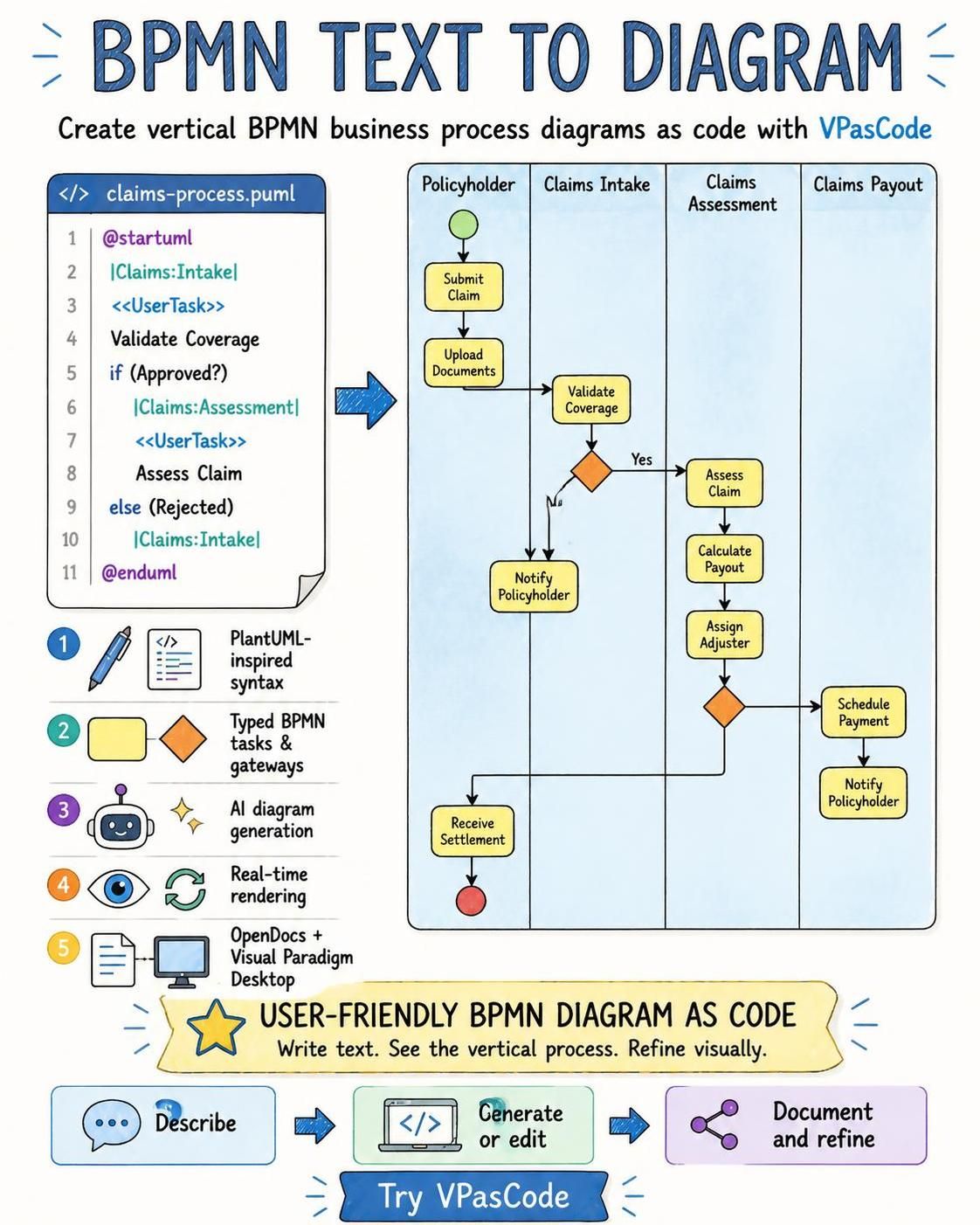
In the evolving landscape of business process management, VPasCode represents a significant shift towards “Diagram as Code.” This methodology allows organizations to define complex BPMN (Business Process Model and Notation) workflows using a text-based syntax inspired by PlantUML. By treating diagrams as editable code, teams can leverage AI to generate initial drafts, utilize version control systems, and maintain precise synchronization between technical documentation and actual process logic.
This tutorial explores the architecture of VPasCode, analyzing the vertical BPMN workflow for an insurance claims process. We will break down how text inputs translate into visual swimlanes, decision gateways, and task flows, demonstrating the efficiency of this modern modeling approach.
Core Architecture of the VPasCode Workflow
The system architecture depicted in the reference material outlines a seamless pipeline that bridges the gap between natural language ideas and executable process models. The workflow is designed to be iterative, combining the speed of text-based editing with the precision of visual modeling.
- Input Phase: The process begins with a natural language description or a direct code snippet. VPasCode utilizes AI to interpret these inputs and generate an initial BPMN draft.
- Editing & Refinement: Unlike static images, the generated model exists as code. Users can adjust task types, modify swimlanes, or alter branching logic directly in the text editor.
- Rendering & Preview: A real-time rendering engine interprets the code to display the vertical BPMN diagram, ensuring immediate visual feedback.
- Export & Integration: The final output can be shared via URL or exported in standard formats (SVG, PNG, PDF). Furthermore, the text file can be integrated into OpenDocs for technical documentation or sent to Visual Paradigm Desktop for advanced visual adjustments.
Deconstructing the Claims Process Code
The core of VPasCode lies in its ability to parse structured text into semantic BPMN elements. The example provided illustrates a vertical process where “Policyholder” initiates the flow, passing through “Claims Intake,” “Assessment,” and “Payout” phases.
Below is the code snippet representing the claims process, demonstrating how semantic tags define the structure:
@startuml
|Claims:Intake|
<>
Validate Coverage
if (Approved?)
  |Claims:Assessment|
  <>
  Assess Claim
else (Rejected)
  |Claims:Intake|
@enduml
Key Syntax Components
Understanding the syntax is essential for mastering VPasCode. The snippet above utilizes specific conventions to map logic to the visual diagram:
- Swimlane Definition: The vertical bars
|Claims:Intake|and|Claims:Assessment|act as delimiters. When the parser encounters these tags, it creates a new vertical column (swimlane) in the diagram, assigning subsequent tasks to that specific role or department. - Task Typing: The tag
<<UserTask>>instructs the renderer to draw a standard rounded rectangle, typical for human-driven activities. This allows for semantic clarity without manual styling. - Conditional Logic: The
if (Approved?)block introduces a decision point. The parser automatically generates an Exclusive Gateway (the diamond shape) to split the flow into two paths: the Yes branch (Assessment) and the Else branch (Rejection/Intake).
Visualizing the Logic Flow
The power of this system is evident when comparing the text to the resulting visual diagram. The code dictates a clear vertical progression:
- Initiation: The process starts at the top of the
|Claims:Intake|lane with a green start node. - Validation: The first task is Validate Coverage. This is a prerequisite step before any assessment can occur.
- Decision Gateway: Upon completion of validation, the flow hits a decision diamond. The diagram explicitly labels the outgoing paths as Yes and No (implied by the else statement).
- Assessment Path (Yes): If approved, the flow moves to the
|Claims:Assessment|lane. Here, the Assess Claim task is executed, followed by calculating the payout and assigning an adjuster. - Rejection Path (Else): If rejected, the flow loops back to the
|Claims:Intake|lane, effectively re-engaging the intake process or notifying the policyholder to resubmit.
Conclusion: The Future of Process Documentation
VPasCode offers a pragmatic solution for modern organizations. By adopting a “Code as Diagram” philosophy, teams can ensure that their process documentation is never obsolete. Since the source of truth is a text file, it can be easily version-controlled in Git, reviewed by peers, and modified by developers alongside application code.
Whether documenting an insurance claims workflow or modeling a complex supply chain, VPasCode proves that text-based modeling is not just a novelty, but a robust engineering practice that enhances collaboration and efficiency.